
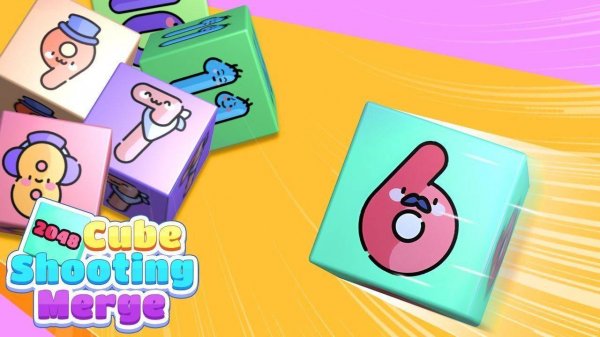
Cube Merge 3D: Number Strategy
Review
Cube Merge 3D transforms the familiar number-merging formula by adding a third dimension and realistic physics. The aiming mechanic requires genuine skill, as each launch must account for angles and bounces. The clean visuals keep the action clear, while the gradual difficulty increase provides lasting challenge. It is a solid choice for puzzle fans who enjoy thoughtful, non-violent gameplay.
Full story
Core Concept & Spatial Challenge
Unlike traditional grid-based number puzzles, this game introduces a dynamic third dimension. Cubes occupy a physical arena where each new piece must be launched from a fixed position. The challenge lies not just in matching numbers, but in predicting how cubes will interact after release. Bounces off walls and existing cubes create unpredictable patterns, requiring players to think several moves ahead. The goal is to keep the arena clear by merging cubes of equal value, with each successful combination producing a cube with a doubled number. As the space fills, every shot becomes more critical, turning each session into a test of spatial reasoning and foresight.
Aiming & Trajectory Mechanics
Players control a launcher at the arena's edge, using mouse or touch controls to set direction and power. The trajectory is influenced by the cube's weight and the angles of surrounding objects. A direct hit on a matching cube triggers an immediate merge, but skilled players can use wall rebounds to reach clusters that are otherwise blocked. This adds a layer of depth beyond simple matching, as the physics engine introduces real-time consequences for each decision. Over time, players learn to read the arena's layout and anticipate how cubes will settle after collisions.
Visual Style & Accessibility
The game presents a clean, colorful interface with clear number labels on each cube. The 3D environment is rendered without clutter, making it easy to track individual pieces even as the arena becomes crowded. Animations are smooth and satisfying, with merges producing a brief visual effect that confirms success. The design avoids any themes or imagery that might be unsuitable for younger players, making it appropriate for family gaming sessions. Controls are responsive across devices, whether played on a desktop computer or a tablet.
Progression & Difficulty Curve
Early rounds allow generous space and fewer cubes, giving newcomers time to learn the physics and aiming system. As play continues, the arena fills more quickly, and cubes appear at a faster rate. This gradual increase in pressure encourages players to refine their strategies rather than relying on luck. The absence of a timer means each move can be considered carefully, which suits a thoughtful, puzzle-solving approach. Reaching higher-number cubes becomes increasingly satisfying as the arena demands more precise planning and efficient merges.
Strategic Depth for Repeat Play
Because each session starts with a different arrangement of cubes, no two games play exactly alike. Players develop personal techniques for managing space, such as focusing on one corner or attempting chain reactions through angled shots. The physics system ensures that even a well-planned shot can lead to unexpected outcomes, adding a layer of replayability. For those who enjoy analyzing their performance, the game provides feedback on the highest cube achieved and the total number of merges, offering a benchmark for improvement over time.






Reader Comments
Sign in to comment
You must be logged in before posting a review or rating.
No account? Create one
No comments yet. Be the first to comment!